

RE-ORG WORKSHOP - COLLECTION MANAGEMENT AND TRAINING WORKSHOP, KORZOK MONASTERY
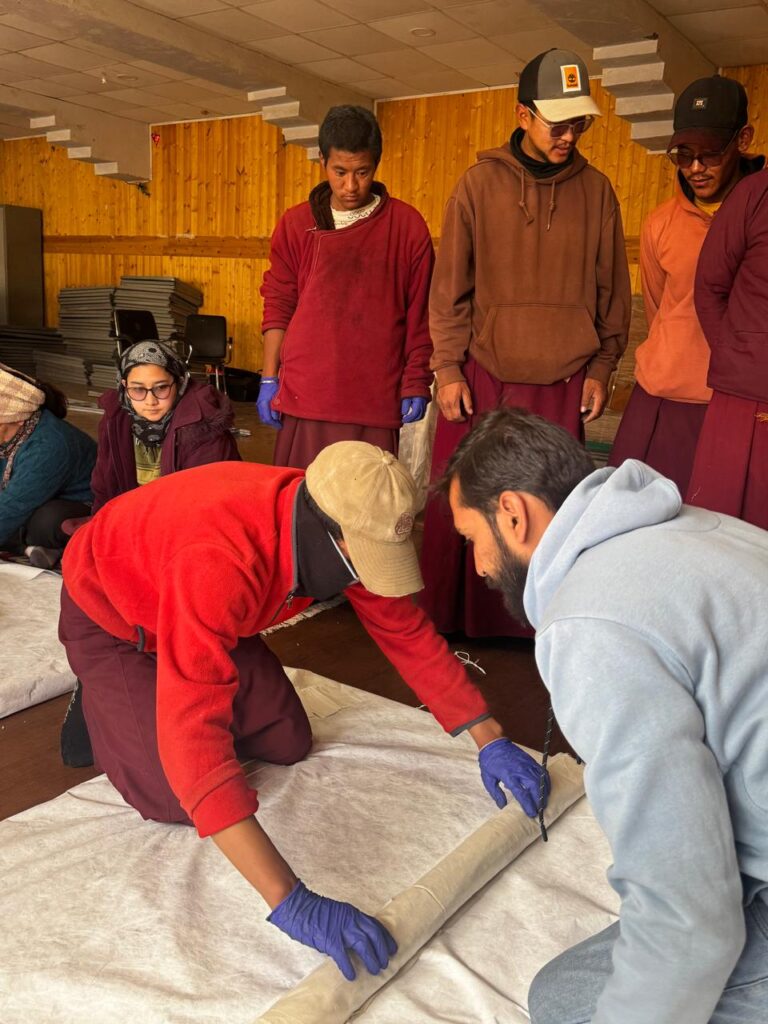
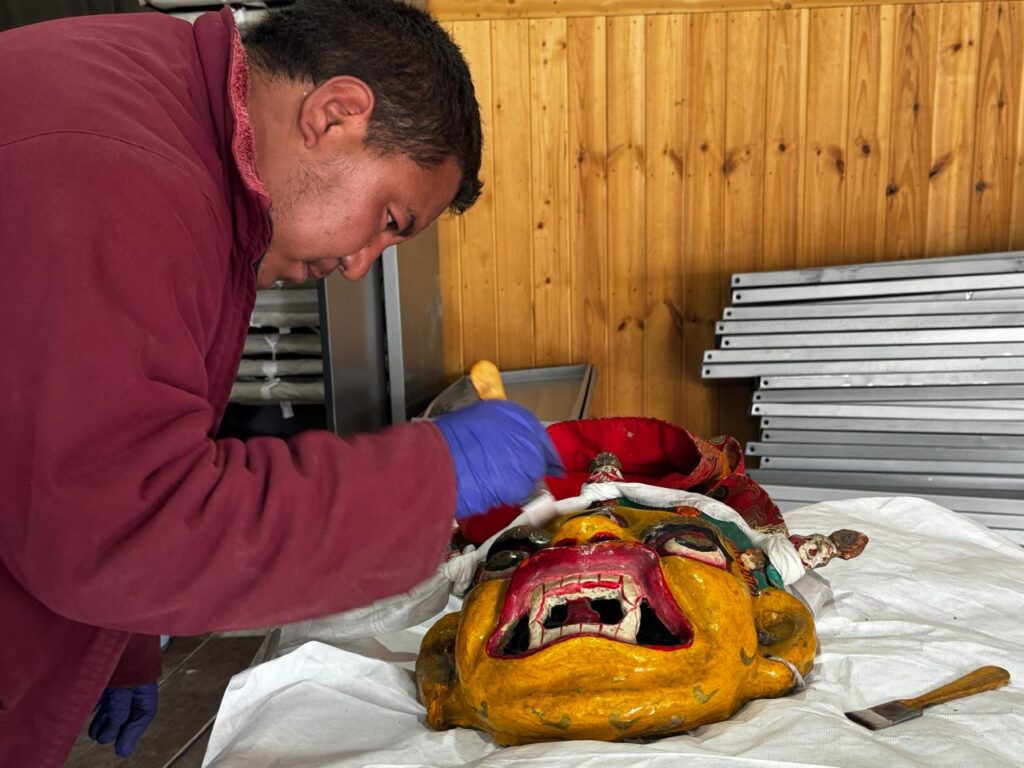
In June 2026, a major collection storage and management initiative was undertaken at Korzok Monastery as part of Jungwa Foundation’s ongoing partnership with the monastic community. Organised in collaboration with the Indira Gandhi National Centre for the Arts (IGNCA), the RE-ORG workshop introduced international standards and best practices in collection storage and preventive conservation.
The first workshop of its kind in Ladakh, the initiative marks an important milestone in building conservation skills within the monastic community. Young monks participated actively in the hands-on training, working with the monastery’s invaluable collection of thangkas, ritual costumes, masks and sacred objects. Each object was carefully examined, cleaned, documented, packed and reorganised within specially designed storage units to improve its long-term care and protection.
The workshop represents the first stage of a longer-term programme for the conservation of Korzok Monastery’s collections. Building on this foundation in preventive conservation, the programme will develop further training for monks, strengthening their capacity to care for and conserve the collections under their stewardship and ensuring that this important cultural heritage is safeguarded for future generations.
MAPPING THE LIVING MEMORY OF NOMADIC ROUTES
The Changpas of Korzok Tegazung are the largest remaining group in Changthang to still follow the rhythms of nomadic pastoralism—a way of life that many others have left behind. Their intimate knowledge of the migratory landscape is not recorded on paper but carried in memory, refined over centuries of movement across the high-altitude plateau. Every route is a thread in a vast mental map, stitched together with landmarks, grazing grounds, and seasonal water sources. This deep familiarity with the land not only guides their journeys but also allows them to sense subtle changes brought about by extreme weather or shifting climates.
In 2019, the Foundation began an ambitious effort to record these ancestral routes—a “living map” that continues to grow each year. Alongside the geography, we are documenting the cultural meanings of place names, stories associated with each site, and memories of paths now rarely travelled, such as the old trade routes that once connected Korzok to the outside world.
This work is expanding into a larger project to trace the migration patterns of over twenty Changpa and semi-nomadic groups across Changthang. Many of these groups have now settled in villages across Durbuk and Nyoma, and their migration memories rest with the elders. By engaging local youth to gather and preserve this knowledge, we are piecing together a detailed map of Changthang—one that reveals the intricate web of routes that once crisscrossed the plateau, carrying with them the lifeblood of nomadic culture.

SAFEGUARDING INTANGIBLE CULTURAL HERITAGE
Ritual arts and performances are at the heart of Korzok’s intangible cultural heritage, deeply intertwined with the life of the 17th-century Korzok Monastery. Archival photographs from the 19th century depict a strikingly simple landscape — the monastery standing alongside the residence of the Rupshu Goba as the only two permanent structures in the settlement.
Today, the monastery remains a living repository of sacred knowledge, artistry, and performance. The annual summer monastery festival marks a high point in the Changpa calendar, drawing the community together in celebration and devotion. During this time, elaborate ritual arts are created: intricate kilkhor (sacred ephemeral mandalas), exquisitely modelled torma (sculptures of dough and butter), and the highly symbolic cham dances — each a visual and spiritual expression of the monastery’s traditions.
Since 2019, in collaboration with the monastery, the Foundation has been conducting a series of specialised training workshops for monks to safeguard these fragile traditions. The first workshop focused on creating kilkhor dedicated to the monastery’s protector deity, Gonbo, and crafting torma for Ishey Gonbo, Paldan Lhamo, and other protector deities. It also revived three important chams: Nya Cham, Don Cham, and Zor Cham.
In 2021, the second workshop brought attention to the Guru Tsangyat Chams — the eight manifestations of Guru Padmasambhava. Senior monks from Hemis and Chemday monasteries led intensive training, culminating in the first performance at Thukje, now a much-anticipated annual tradition.
The third workshop in 2022 turned to the monastery’s intricate knowledge system of skar tsis rigpa (astrology), ensuring its transmission to the next generation.
Building on the momentum of these initiatives, the Foundation is currently producing a documentary film that views climate change through the cultural lens of Korzok, revealing how intangible cultural heritage not only preserves identity but also frames the community’s relationship with a rapidly changing environment.


RESTORATION OF MANE WALLS
The high-altitude landscape around Korzok is threaded with long, low rows of mane walls—stone structures embedded with slabs inscribed with sacred Buddhist mantras, most often the timeless Om Mani Padme Hum. These walls are more than markers along the nomadic routes of the Changpas; they are spiritual waypoints, meant to be passed on the left as a gesture of reverence, weaving prayer into every journey.
Over decades of harsh weather, shifting ground, and the passage of time, many mane walls had crumbled, their stones displaced and their inscriptions scattered. Recognising their cultural and spiritual significance, the Foundation, in collaboration with the Korzok village community and the Korzok Monastery, undertook a restoration initiative.
Nearly forty mane walls were painstakingly repaired, each stone carefully set back in place. Monks guided the process, ensuring the proper placement and orientation of the sacred inscriptions. This was not simply a construction effort—it was an act of devotion, with each restored wall reviving an ancient rhythm in the Changpa landscape. The restored mane walls now stand once again as sentinels of faith, guiding both the physical and spiritual journeys of all who pass through this vast, windswept terrain.

DOCUMENTATION OF TRADITIONAL ECOLOGICAL KNOWLEDGE
In the high-altitude grasslands of Changthang, life for the Changpa pastoral nomads is inseparably tied to the land. Here, traditional ecological knowledge (TEK) — passed down through generations — shapes how the community interacts with its environment. Central to this knowledge is a deep understanding of the region’s plant species, which sustain their livestock and support the traditional amchi system of medicine.
In 2024, we undertook a detailed documentation of this knowledge system, combining interviews with community elders, on-ground fieldwork, and a review of secondary sources. The result was a comprehensive inventory of indigenous plants used for grazing, medicine, and the extraction of natural dyes.
This living record goes beyond taxonomy — it reflects a cultural relationship with the land. A workshop with nomadic women weavers brought this knowledge to life, as they experimented with extracting pigments from local plants to dye handspun wool, reviving age-old methods that are both sustainable and culturally resonant.
Funded by the Shrikant Joshi Endowment Fund managed by Keystone Foundation, the study identified 48 species of fodder and medicinal plants thriving at nearly 4,500 meters above sea level in the Korzok–Tegazung nomadic pastoral landscape. Belonging to 21 botanical families, the most prominent were Asteraceae, Boraginaceae, Fabaceae, and Polygonaceae — a testament to the region’s remarkable biodiversity and the Changpa community’s enduring role as its custodians.


NATURE GUIDES TRAINING WORKSHOP
In 2022, Jungwa Foundation, in collaboration with the Department of Wildlife Protection, UT Ladakh, and in partnership with Titli Trust and CEDAR, organised a Nature Guides Training Workshop to explore the potential of bird and butterfly-based ecotourism in Ladakh.
Designed by Sanjay Sondhi of Titli Trust, the workshop was the first in a series of modules introducing participants to ecotourism and the rich bird and butterfly diversity of Ladakh. Fifteen participants attended, divided into five groups, each equipped with a kit containing a camera, binoculars, and reference books and brochures on the birds and butterflies of Ladakh and the wider Indian subcontinent.
Conducted over eight days, the programme included classroom sessions with experts Sanjay Sondhi and Dr. Pia Sethi, film screenings, and field visits to Changthang. On the final day, Shri Tashi Namgail Yakzees, Hon’ble Executive Councillor from Changthang, presided as Chief Guest, presenting certificates and commending the Foundation’s efforts. He also shared the Ladakh Autonomous Hill Development Council’s vision for promoting community-based ecotourism in the region.
The second workshop module was held in September 2022, again with Titli Trust, led by renowned naturalist Sanjay Sondhi. Following its completion, participants formed the Young Naturalists of Ladakh (YNL), a group supported by Jungwa Foundation. YNL members now regularly upload checklists and images from their field visits to citizen science platforms such as eBird and lead school nature walks organised by the Foundation.
